- Gorick's Newsletter
- Posts
- You’re evaluated on more than what’s visible
You’re evaluated on more than what’s visible
Showing more than what’s on paper

Gorick Ng
January 20, 2026 • Read Time:4 minutes

I love movies (proof is in my Spotify Wrapped and my prior story on Star Wars!), which means I’m always finding myself in a Google rabbit hole when I watch one. Here’s a recent result of that curiosity. Enjoy!
TODAY’S TAKEAWAY
You’re evaluated on more than what’s visible.
You may think the most important things on your resume are your years of experience or your number of credentials. But sometimes what truly matters (to your current or future employer) is what’s unspoken.
THE STORY
A physics professor is selected for an unlikely role
You may have heard of or even seen the movie Oppenheimer (2023), which follows the true story of J. Robert Oppenheimer and the creation of the atomic bomb.
But did you know that tucked behind the Oscar-winning movie is a career lesson on how to become the no-brainer pick for a high-stakes role?
In 1942, the U.S. was racing to build a nuclear weapon before Nazi Germany could develop one. The fear was that if the Nazis succeeded first, they could win World War II—and dominate the world with its nuclear might.
So, the Manhattan Project was born—a top-secret U.S. government program to design and build the atomic bomb.
To succeed, the U.S. needed someone to lead the Los Alamos laboratory, the project’s scientific hub. This leader had to do more than understand science. They had to unite a diverse range of personalities and translate theory into a practical weapon.

J. Robert Oppenheimer teaching in the field of quantum mechanics.
That’s where J. Robert Oppenheimer came in. At the time, he was a physics professor at UC Berkeley who had “earned the respect of scientific greats such as Albert Einstein.”
But he was also “absolutely the most unlikely choice.” He wasn’t a Nobel laureate, hadn’t led large teams, and lacked wartime leadership experience.
Yet General Leslie Groves, the commanding general on the Manhattan Project, chose Oppenheimer despite receiving “only opposition.”
Why?
Because Groves saw that Oppenheimer had a certain “charisma, ambition, and brilliance”—that could make him capable of the impossible.
Groves’ “leap of faith” proved right.
Oppenheimer, in addition to his technical skill, had a unique ability that others didn’t: he could “take scientists with different perspectives and bring them to a consensus.”
Oppenheimer’s leadership at Los Alamos succeeded in terms of what mattered most when he was hired: delivering the world’s first atomic bomb on July 16, 1945, before Nazi Germany.
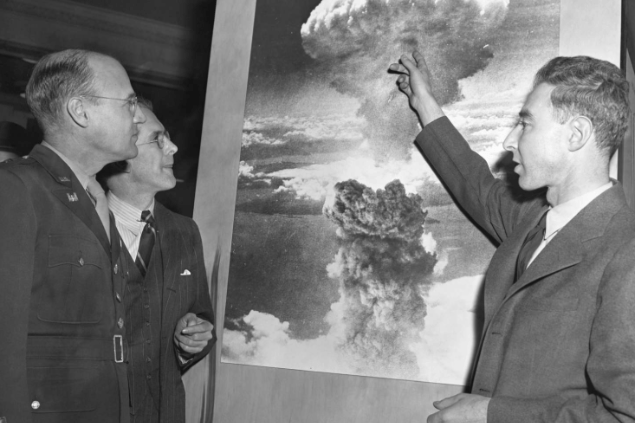
J. Robert Oppenheimer points to a photo of a mushroom cloud from the atomic bomb.
A chance to make a positive impact:
Give first-generation students the advice that you wish you’d had!

Looking for a way to make an impact in the new year?
CareerSpring is a non-profit organization that helps empower FGLI (first-generation, low-income) students across the United States in their career journeys.
As a Volunteer Advisor, you’ll get the chance to help someone who wants to follow in your footsteps and pass on the advice that you wish you’d gotten sooner.
I’m a Volunteer Advisor myself and always feel that the time was well spent. I hope you get a chance to see what I mean!
Register as a volunteer here: https://www.careerspring.org/interest-form
(There are no long-term commitments required. Sessions are held virtually for 30 minutes, scheduled entirely at your convenience.)
THE UNSPOKEN RULE
You’re evaluated on more than what’s visible
Looking for a new job or trying to get promoted? You may think that in order to be the best candidate, you need to fit the bill perfectly.
But that’s not always true! Like Oppenheimer, you’re being evaluated on more than what shows up on your resume or LinkedIn profile.
Consider these 2 ways to stand out:
If you’re early in your career, you may not have all the years of experience that a resume says are “required”, but you may still have the skills that are wanted—and needed. Try reframing your experience with these fill in the blanks:
“While my [role / position] with ______ was about ______ on the outside, it was really about ______ at the end of the day—which is also the focus of [future area] and a realm that I’d really like to continue [exploring / working in / applying my skills to / ______].”
If you’re mid- or late-career, you may have all the years of experience and more as required by a job description, but still find yourself competing against younger or cheaper talent. When asked to walk others through your resume or to introduce yourself, don't just stick to the bullet points you’ve already written! Make sure to also add a phrase like this:
“Beyond what's written on my resume, I also wanted to add that during ______, my [firm / company / program] went through [change / crisis]. I became the go-to person for ______ and even [led / architected / sold] ______ which is directly analogous with what you're trying to do with ______ with the only difference being ______.”
Oppenheimer wasn’t chosen because of what was most visible. He was chosen because of what was valuable. Make sure you share what sets you apart because people can’t give you credit for something that they don’t even know about.
See you next Tuesday for our next story and unspoken rule,
Gorick
WHAT I’M READING
Here are 3 articles that I found interesting recently (no paywalls, although it may depend on your cookies):
“Changing careers: ‘My job began to feel hollow ... I felt I’d lost myself somewhere’” (The Irish Times)
“Where homes are most (and least) affordable” (Axios)
“They were told they could have it all. So why are so many moms leaving their jobs?” (USA Today)
MORE OF MY WORK
Every newsletter is free and a fraction of my work. Here are 4 of my paid offerings that may interest you:
1. Keynote speaking: If your organization is looking for speakers for your internship program, new hire orientation, new student orientation, manager training, all-hands meetings, recruiting season, year-end performance evaluation season, or something else, let's chat!
2. How to Say It: Flashcards that teach you to know what to say in every high-stakes professional setting via hundreds of fill-in-the-blank scripts (just like the examples above). Free shipping on all orders over $40.
3. The Unspoken Rules: My Wall Street Journal Bestseller that Arianna Huffington calls “a blueprint for anyone starting their career, entering a new role, or wanting to get unstuck.” Used by top companies and MBA programs.
4. Soft skills crash course: Hard skills get you hired, but a lack of soft skills gets you fired. Equip your interns and early career talent with the essential behaviors of high performers in just 3.5 hours.

Gorick Ng
[email protected]
Harvard career advisor | WSJ bestselling author | Fortune 500 keynote speaker | First-gen
Follow me on LinkedIn
Ask me a career question
STORY SOURCES
unprecedented, top-secret government program to design and build the atomic bomb.
“earned the respect of scientific greats such as Albert Einstein.”
“take scientists with different perspectives and bring them to a consensus.”
J. Robert Oppenheimer teaching in the field of quantum mechanics.
J. Robert Oppenheimer points to a photo of a mushroom cloud from the atomic bomb.